
OTWONO LABS / NOTEBOOK
Clear writing: give a reader what they need to act
Learn one step at a time, with examples, practice and a place for your questions.
Start this lessonPractical communication · LESSON 1 OF 4
Replace a vague message with a specific instruction while preserving what is known and unknown.
Before you start: Read short sentences. No grammar terminology is required.
Suggested pace: 20 to 35 minutes, with extra time for practice. You can stop after any section and return.
Start with something concrete
You receive ‘Prepare for the changes tomorrow.’ You may understand every word but still have no idea what to do. Clear writing is not just correct spelling. It gives the intended reader enough information to understand the situation and take the right action.
The words we will use
- Audience
- The people who will read the message.
- Purpose
- What the message should help them understand or do.
- Context
- The details needed to interpret the message correctly.
- Qualification
- Wording that limits a claim, such as expected or possible.
Understand the idea
Before rewriting, identify the reader’s questions. In a meeting change, they may ask: Which meeting? What changed? Where should I go? When? What should I bring? Include confirmed answers that matter for this audience.
Replace vague references with concrete ones. ‘It’ can become ‘the revised cover image.’ ‘Soon’ can become a confirmed date and time. A precise detail is only helpful if it is true; never invent it to make a sentence sound complete.
Preserve uncertainty. ‘The time is still being arranged’ tells the reader something important. Removing that qualification can accidentally turn an expectation into a promise.
Teacher example: rewrite a meeting notice
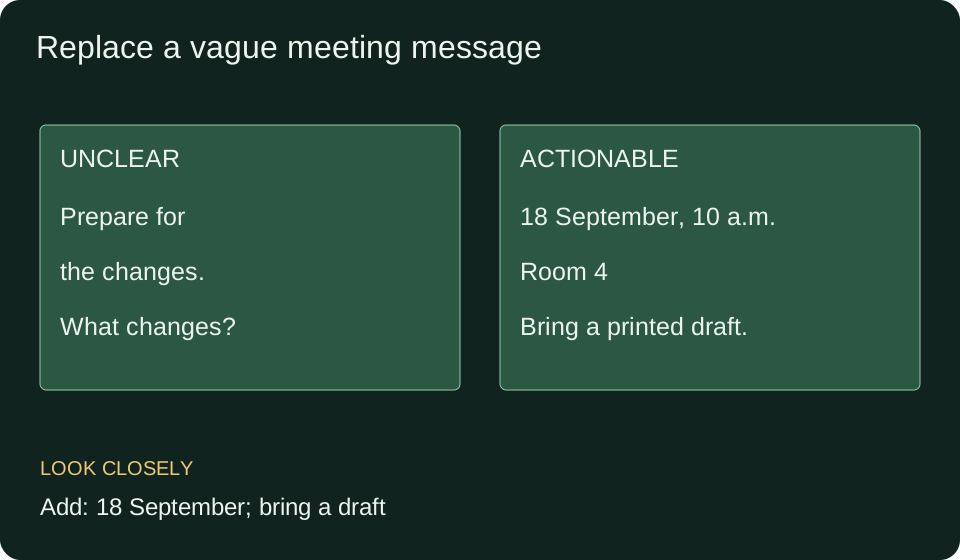
- Known facts: design review, 18 September, 10 a.m., room 4, printed draft required.
- State the event and location: ‘The design review on 18 September will meet in room 4 at 10 a.m.’
- State the action: ‘Please bring a printed draft.’
- If the audience needs a building or time zone, obtain and add it. Do not assume the existing wording is sufficient for every reader.
Connect the example to the rule
Shorter is not always clearer. A few added words can prevent a long exchange of questions. Remove repetition after checking that you have kept the event, responsible person, action and important conditions.
Your turn, with support
The meeting room is confirmed as room 4, but the time is unknown. Write one accurate sentence.
Show one hint
State the confirmed detail and leave the unresolved detail visible.
Compare your working
The meeting will be in room 4; the time is still being confirmed. Other faithful wordings are possible.
A mistake worth understanding
Changing ‘Early tests suggest the layout may reduce confusion’ to ‘The layout eliminates confusion’ changes the claim. The original expresses limited evidence and uncertainty; the rewrite promises much more.
Check the idea before moving on
The interactive questions load when JavaScript is available. You can still use all written practice below.
Now solve without the example
- Rewrite ‘Send it soon’ using these facts: revised cover, to Priya, by 3 p.m. on 20 September.
- A button saves a draft but does not send it. Choose a truthful label.
- Name a missing detail in ‘Registration closes at noon.’
Check the independent answers
- Please send the revised cover to Priya by 3 p.m. on 20 September. Add the time zone if the audience needs it.
- Save draft.
- The date or time zone may be missing, depending on context.
Use it in a new situation
Write a two sentence instruction for someone joining a fictional reading group. Identify which details you invented for the exercise and which would need confirmation in real use.
Compare a possible solution
One possible structure is an event sentence with confirmed time and place, followed by a preparation or reply request. There is no single required wording; the test is whether the reader can act without guessing.
What to take away
Identify the reader and purpose, supply necessary facts, make the action concrete and preserve uncertainty.
Before your next lesson
Close this page and explain the main idea in your own words. Rework one of the independent problems without looking. If a step is still unclear, return to the worked example and compare that exact step. Tomorrow, try the transfer problem again before opening its answer.
For a saved introductory check, open this lesson in your signed in workspace and choose Tests. Practice choices on this page are not a qualification or a substitute for independent work.
Next in this path: Project planning: understand what can happen together