
OTWONO LABS / NOTEBOOK
Project planning: understand what can happen together
Learn one step at a time, with examples, practice and a place for your questions.
Start this lessonPractical communication · LESSON 2 OF 4
Build a simple schedule from prerequisites and explain why working hours can differ from elapsed hours.
Before you start: Add small durations. No project management experience is needed.
Suggested pace: 20 to 35 minutes, with extra time for practice. You can stop after any section and return.
Start with something concrete
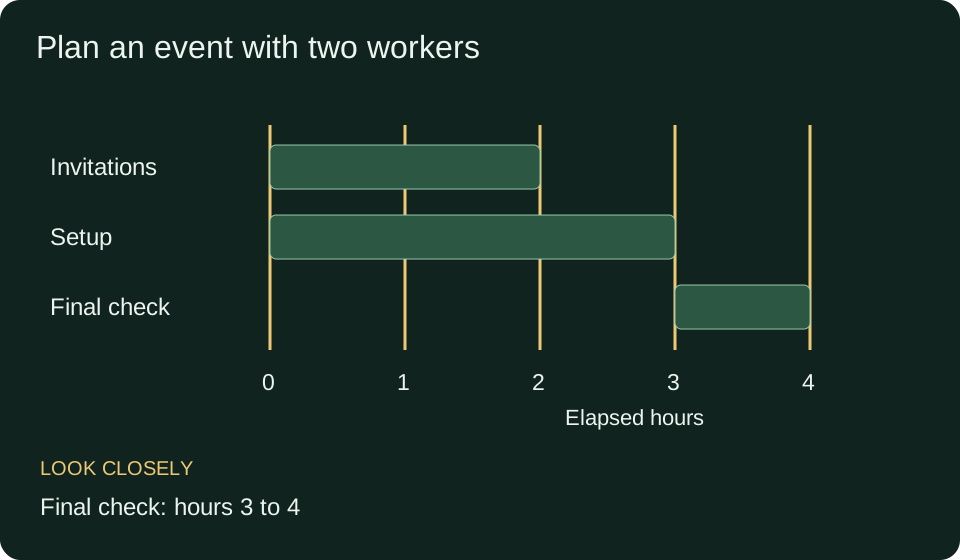
You are preparing a fictional event. Invitations take two hours. Room setup takes three hours. A final check takes one hour and must wait until both are finished. There are two available workers, so preparation can happen at the same time.
The words we will use
- Task
- A piece of work with a defined result.
- Dependency
- A requirement that another task finish before this task starts.
- Duration
- How long a task takes under the stated conditions.
- Elapsed time
- Time from the start of the project to its finish.
Understand the idea
A task list names the work. A dependency plan also states what must happen first. The final check has two prerequisites: invitations and setup. It cannot begin when only one is ready.
If independent tasks have enough resources, their time can overlap. Both preparation tasks begin at hour zero. Invitations finish at hour two, but setup finishes at hour three. The check therefore waits until hour three.
Add the check’s one hour to its start at three. The event is ready at hour four. The labor total is two plus three plus one, or six hours, because two workers were busy during part of the same elapsed period.
Teacher example: read the event schedule
- Start invitations and setup at hour zero with separate workers.
- Invitations finish at hour two. Setup is still running.
- At hour three, both preparations are ready and the final check starts.
- At hour four, the check finishes. This is the earliest finish under the stated assumptions.
Connect the example to the rule
Resources matter as much as arrows. With one person required to do all three tasks, the same overlap is unavailable. The work takes six working hours if done consecutively without gaps. Real plans also need breaks, approvals and uncertainty considered separately.
Your turn, with support
Setup now takes five hours. Invitations still take two and the final check one. With two workers, when does the project finish?
Show one hint
The final check waits for the later preparation finish.
Compare your working
Hour six. Setup ends at five; the check then takes one hour.
A mistake worth understanding
Shortening invitations from two hours to one does not shorten the original four hour schedule. Setup still finishes at three and controls when the check can start. Saving labor is useful, but it is not always a shorter elapsed schedule.
Check the idea before moving on
The interactive questions load when JavaScript is available. You can still use all written practice below.
Now solve without the example
- Two parallel tasks take three and five hours. A two hour review needs both. Find the finish.
- What happens if the five hour task drops to four hours?
- An approval wait has unknown duration. How should the plan show it?
Check the independent answers
- Hour seven.
- The review starts at four and finishes at six.
- Show approval as a dependency with unknown duration or explicit scenarios. Do not silently count it as zero.
Use it in a new situation
For a podcast, recording must precede editing. Artwork can be made separately. Upload needs edited audio and artwork. What resource question should you ask?
Compare a possible solution
Ask whether the same person must edit and create artwork. Logical independence does not guarantee that the work can overlap.
What to take away
List tasks, identify prerequisites, check resources and start each task only when all required inputs are ready.
Before your next lesson
Close this page and explain the main idea in your own words. Rework one of the independent problems without looking. If a step is still unclear, return to the worked example and compare that exact step. Tomorrow, try the transfer problem again before opening its answer.
For a saved introductory check, open this lesson in your signed in workspace and choose Tests. Practice choices on this page are not a qualification or a substitute for independent work.
Next in this path: Organizing information: make the right item easy to retrieve