
OTWONO LABS / NOTEBOOK
Troubleshooting: narrow a problem before choosing a solution
Learn one step at a time, with examples, practice and a place for your questions.
Start this lessonInvestigating problems · LESSON 1 OF 3
Separate what you observed from what you inferred and choose a check that distinguishes possible explanations.
Before you start: No repair experience is needed. We use a fictional lamp comparison to practice reasoning, not to instruct electrical repairs.
Suggested pace: 20 to 35 minutes, with extra time for practice. You can stop after any section and return.
Start with something concrete
A lamp does not light. Saying ‘the bulb is broken’ is a hypothesis. Saying ‘the lamp did not light when tested’ is an observation. The same observation could have several explanations, so the first guess should not automatically become the diagnosis.
The words we will use
- Observation
- Something directly noticed or measured.
- Hypothesis
- A possible explanation that can be checked.
- Diagnostic check
- A comparison that helps distinguish explanations.
Understand the idea
List plausible places where the process could fail. In a simplified example, the outlet, the lamp or a connection could be involved. The purpose of a check is to narrow the possibilities, not to confirm the first idea you liked.
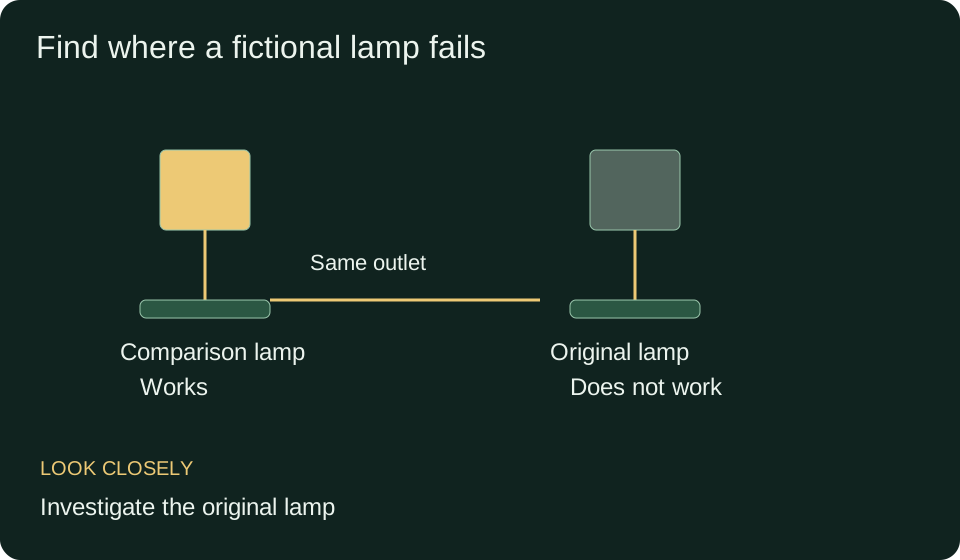
Compare under controlled conditions. If another known working lamp operates at the same outlet, that provides evidence that the outlet can supply the comparison lamp at that moment. The original lamp still failing points toward differences involving that lamp or its connection.
Do not claim more than the check establishes. It does not identify an internal component with certainty, nor prove that the outlet can never have intermittent faults. Record the remaining uncertainty before selecting the next safe action.
Teacher example: compare two lamps
- Observation: the original lamp fails to light.
- Comparison: a known working lamp lights at the same outlet.
- Inference: investigate what differs about the original lamp or its connection.
- Limit: this comparison alone does not prove the original bulb is the faulty part.
Connect the example to the rule
A useful record has three lines: observation, possible explanation and next distinguishing check. In real electrical work, follow manufacturer guidance and use qualified service. If a proposed test is unsafe, do not perform it merely because it would provide information.
Your turn, with support
Someone concludes that the original bulb is definitely faulty. Which part of the comparison supports narrowing the problem, and which part of the claim remains unproven?
Show one hint
Did the comparison inspect or isolate the bulb itself?
Compare your working
The working comparison lamp narrows attention toward the original lamp or its connection. It did not isolate the bulb, so a specific component diagnosis remains unproven.
A mistake worth understanding
Changing several things at once may make the problem disappear without showing which change mattered. When safe and practical, a focused comparison gives a more interpretable result.
Check the idea before moving on
The interactive questions load when JavaScript is available. You can still use all written practice below.
Now solve without the example
- Classify ‘The page returned an error’ as observation or hypothesis.
- Classify ‘The server is overloaded’ as observation or hypothesis when no server data has been checked.
- A problem disappears after three settings change. What can you conclude about the cause?
Check the independent answers
- Observation, if that is what was seen.
- Hypothesis.
- You know the combined changes coincided with success. You cannot identify which change was responsible from that test alone.
Use it in a new situation
A printer fails for one document but prints another. What did the comparison narrow, and what should you avoid assuming?
Compare a possible solution
It shows the printer can print the comparison document. It points toward differences involving the failing document or its handling, but does not prove a particular formatting feature is the cause.
What to take away
Observe first, list explanations, choose a safe distinguishing check and update the diagnosis only as far as the evidence permits.
Before your next lesson
Close this page and explain the main idea in your own words. Rework one of the independent problems without looking. If a step is still unclear, return to the worked example and compare that exact step. Tomorrow, try the transfer problem again before opening its answer.
For a saved introductory check, open this lesson in your signed in workspace and choose Tests. Practice choices on this page are not a qualification or a substitute for independent work.
Next in this path: Comparisons: measure a difference without inventing its cause