
OTWONO LABS / NOTEBOOK
If then reasoning: what a rule actually lets you conclude
Learn one step at a time, with examples, practice and a place for your questions.
Start this lessonComputing and logic · LESSON 2 OF 3
Apply a rule in its stated direction and test an invalid reversal using a counterexample.
Before you start: No formal logic is required. We introduce the shapes and terms used in the example.
Suggested pace: 20 to 35 minutes, with extra time for practice. You can stop after any section and return.
Start with something concrete
For this lesson, a rectangle is a four sided shape with four right angles. A square is a rectangle whose four sides are also equal. Therefore every square is a rectangle, but a rectangle can have unequal adjacent side lengths.
The words we will use
- Condition
- The fact after if that activates the rule.
- Conclusion
- The fact the rule guarantees when its condition holds.
- Counterexample
- One case that disproves a general claim.
Understand the idea
Write the rule: If a shape is a square, then it is a rectangle. The condition is being a square. The conclusion is being a rectangle. When the condition is known to hold, the conclusion follows.
Now suppose you only know that a shape is a rectangle. The rule has not told you whether all its sides are equal. You cannot conclude that it is a square from this information alone.
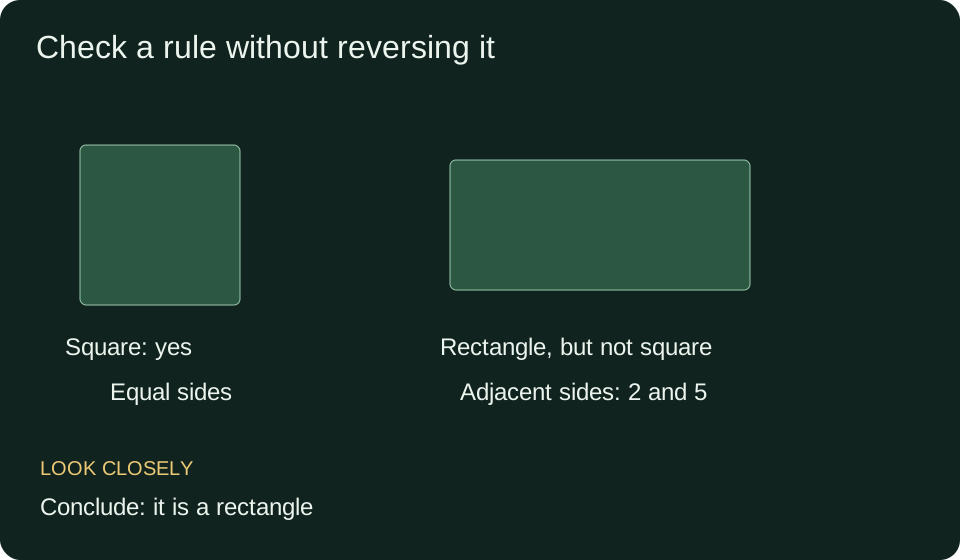
To disprove ‘Every rectangle is a square,’ you do not need to inspect every rectangle. One rectangle with adjacent sides two and five is enough. It has four right angles but does not have four equal sides. That is a counterexample.
Teacher example: apply the rule, then test its reversal
- Observe a square. Its four right angles satisfy the rectangle definition.
- Conclude that the square is a rectangle.
- Observe a rectangle with adjacent sides 2 and 5. It is not a square.
- Conclude that the reversed rule is not valid in general.
Connect the example to the rule
Letters can shorten the same reasoning: If P, then Q. Knowing P allows Q. Knowing Q alone does not establish P. Think of the letters as placeholders for statements, not numbers to calculate.
Your turn, with support
A rule says every member of the advanced club has completed the introductory course. Alex is in the advanced club. What follows? Does completing the introductory course alone prove club membership?
Show one hint
Use the rule from its condition toward its conclusion.
Compare your working
Alex completed the introductory course. Completing that course alone does not prove club membership; there may be other requirements or people who choose not to join.
A mistake worth understanding
Seeing a conclusion and assuming its condition must have caused it reverses the implication. Another route may lead to the same conclusion. Ask whether the rule actually says ‘only if,’ ‘if,’ or both before interpreting it.
Check the idea before moving on
The interactive questions load when JavaScript is available. You can still use all written practice below.
Now solve without the example
- If an item is a red marble, it is a marble. You find a red marble. What follows?
- You find a marble. Must it be red?
- Give a counterexample to ‘Every marble is red.’
Check the independent answers
- It is a marble.
- No. The color has not been established.
- A blue marble is enough to disprove the universal claim.
Use it in a new situation
A system says verified uploads display a check mark. You see a check mark. What would you need to know before treating it as proof of verification?
Compare a possible solution
You need to know that only verified uploads can display that mark and that the display is trustworthy. The forward rule alone does not establish the converse.
What to take away
Identify the condition, identify the conclusion, follow the stated direction and test broad claims with a concrete counterexample.
Before your next lesson
Close this page and explain the main idea in your own words. Rework one of the independent problems without looking. If a step is still unclear, return to the worked example and compare that exact step. Tomorrow, try the transfer problem again before opening its answer.
For a saved introductory check, open this lesson in your signed in workspace and choose Tests. Practice choices on this page are not a qualification or a substitute for independent work.
Next in this path: Procedures: write instructions that handle ordinary and awkward cases