
OTWONO LABS / NOTEBOOK
Fractions from the beginning: different names for the same amount
Learn one step at a time, with examples, practice and a place for your questions.
Start this lessonEveryday mathematics · LESSON 1 OF 6
Explain what a fraction means and show why two different fractions can describe the same amount.
Before you start: You only need to count small groups. We introduce the fraction vocabulary here.
Suggested pace: 20 to 35 minutes, with extra time for practice. You can stop after any section and return.
Start with something concrete
Imagine one rectangular sheet of paper. You fold it down the middle and shade one of the two equal halves. You have shaded one half of the sheet. We write this as 1 / 2: one part counted, out of two equal parts in the whole. The slash means the same thing as the horizontal line in a written fraction.
The words we will use
- Whole
- The complete thing we have chosen to measure, such as one sheet of paper.
- Equal parts
- Pieces that contain the same amount of the whole.
- Fraction
- A number that describes an amount in relation to a whole.
- Denominator
- The bottom number. It tells us how many equal parts make one whole.
- Numerator
- The top number. It tells us how many of those parts we are counting.
Understand the idea
The parts must be equal in amount. Cutting a sheet into one large piece and one tiny piece does not make each piece a half. There are two pieces, but they do not each contain half the sheet. For the strip drawings in this lesson, equal widths and equal heights make equal areas.
Now fold each half into two equal pieces. The whole sheet has four pieces. The region you shaded has not changed, but it contains two of the new pieces. Its new name is 2 / 4. Therefore 1 / 2 and 2 / 4 describe the same shaded amount of this sheet. We call fractions with the same value equivalent.
Notice what changed: the size and number of pieces. Notice what did not change: the whole sheet and the shaded region. This is the reason behind the calculation. We are not making the shaded part larger when we make its numerator larger; we are counting smaller pieces.
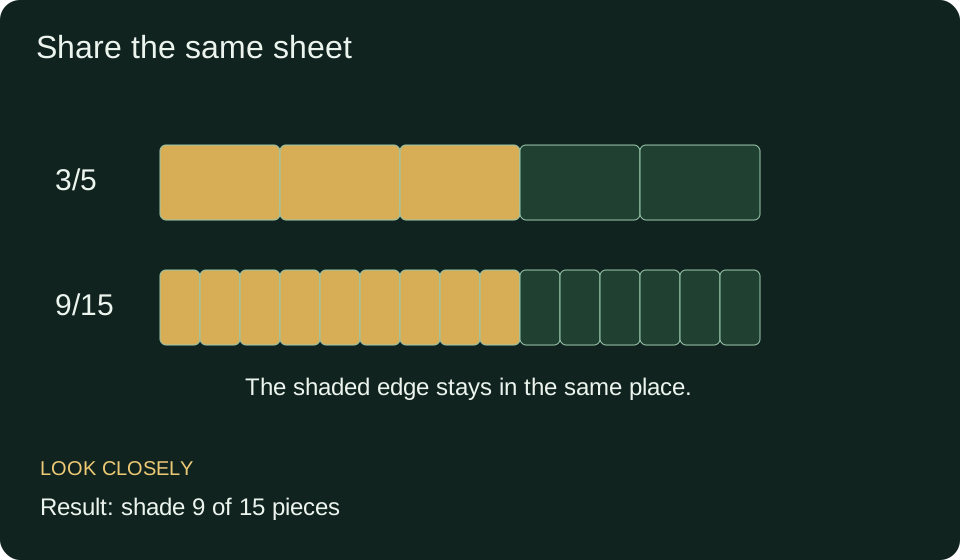
Teacher example: change 3 / 5 into fifteenths
- Start with one rectangle divided into five equal strips. Shade three strips. The shaded amount is 3 / 5.
- Divide every strip into three equal pieces. Do this to the unshaded strips too, so all pieces still have equal areas.
- Count the whole: five groups of three pieces give 15 pieces. This is the new denominator.
- Count the shaded region: three groups of three pieces give nine pieces. This is the new numerator.
- Write 3 / 5 = 9 / 15. The equals sign says that the values are the same. Check the picture: the right edge of the shaded region stays in exactly the same place.
Connect the example to the rule
In numbers, we multiplied both 3 and 5 by 3. Multiplying both counts by the same positive whole number subdivides every piece equally. To reverse the process, we can group pieces using a common factor: 9 / 15 divided at the top and bottom by 3 returns to 3 / 5. Never divide by zero.
Your turn, with support
Complete 2 / 7 = ? / 21. First find how many new pieces replace each seventh. Then count how many lie inside the two selected sevenths.
Show one hint
Seven times what gives twenty one? Apply that same factor to the two selected pieces.
Compare your working
Each seventh becomes three pieces because 7 × 3 = 21. The selected two sevenths become 2 × 3 = 6 pieces. The answer is 6 / 21.
A mistake worth understanding
A learner writes 2 / 5 = 4 / 7 after adding two to both numbers. Adding does not subdivide each original strip equally. A reliable way to check is to use a common denominator: 2 / 5 = 14 / 35, while 4 / 7 = 20 / 35. The shaded amounts would be different.
Check the idea before moving on
The interactive questions load when JavaScript is available. You can still use all written practice below.
Now solve without the example
- Draw one sheet with half shaded. Divide it into six equal pieces. How many pieces are shaded?
- Write 4 / 5 in twentieths. Explain the factor you used.
- Simplify 8 / 12 by grouping pieces. What common factor can you use?
- Is half of a small sheet the same physical area as half of a large sheet? Explain.
Check the independent answers
- Three pieces are shaded: 1 / 2 = 3 / 6. Each half was divided into three.
- 16 / 20. Each fifth becomes four twentieths, so four selected fifths become sixteen pieces.
- 2 / 3, dividing both counts by four. Each group combines four of the original twelfths.
- Not necessarily. The fraction of each whole is the same, but the wholes have different areas.
Use it in a new situation
A progress tracker divides one complete task into twelve equal units. You have completed 5 / 6 of that same task. How many tracker units should be filled? Explain before looking at the answer.
Compare a possible solution
Ten. Each sixth contains two twelfths, so five sixths contain ten twelfths. This assumes the tracker uses equal units for the same complete task.
What to take away
A fraction counts equal parts of a specified whole. Equivalent fractions name the same value. Change both counts by the same factor, then check that the amount has stayed the same.
Before your next lesson
Close this page and explain the main idea in your own words. Rework one of the independent problems without looking. If a step is still unclear, return to the worked example and compare that exact step. Tomorrow, try the transfer problem again before opening its answer.
For a saved introductory check, open this lesson in your signed in workspace and choose Tests. Practice choices on this page are not a qualification or a substitute for independent work.
Next in this path: Ratios: keep a mixture the same while changing its size