
OTWONO LABS / NOTEBOOK
Probability: count the possible outcomes before guessing
Learn one step at a time, with examples, practice and a place for your questions.
Start this lessonEveryday mathematics · LESSON 6 OF 6
Calculate a simple chance by counting equally likely outcomes and update the count when the situation changes.
Before you start: Understand a fraction as a part of a whole. Review the first mathematics lesson if needed.
Suggested pace: 20 to 35 minutes, with extra time for practice. You can stop after any section and return.
Start with something concrete
A bag contains two blue tokens and three white tokens. Imagine the tokens are identical except for color, thoroughly mixed and drawn without looking. Each individual token has the same chance of being selected.
The words we will use
- Outcome
- One possible result of an action.
- Equally likely
- Each individual outcome has the same chance of occurring.
- Probability
- A number describing chance, from zero for impossible to one for certain.
- Favorable outcome
- An outcome that matches the event you are asking about.
Understand the idea
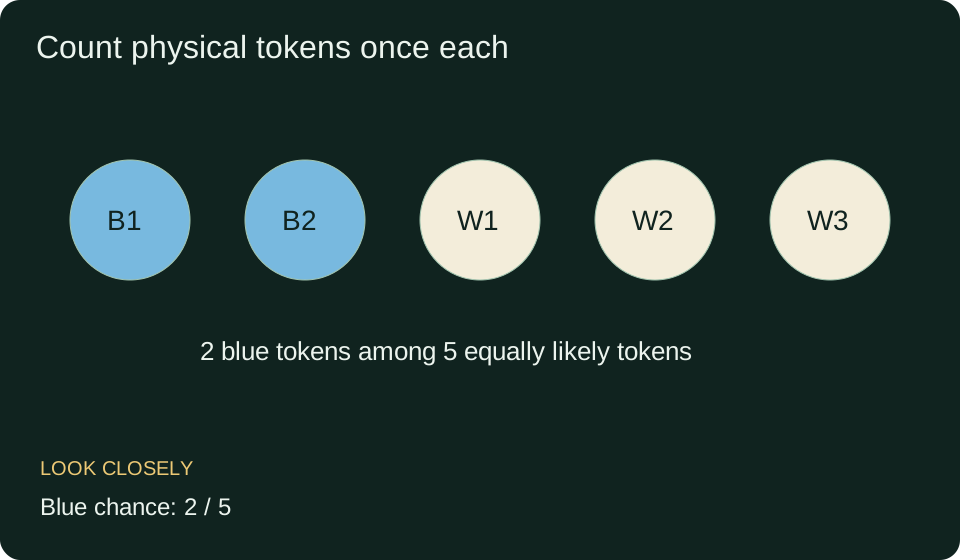
Give the tokens labels B1, B2, W1, W2 and W3. These labels help us count individual possibilities even though some colors repeat. There are five equally likely outcomes.
If the question is ‘What is the chance of blue?’, only B1 and B2 are favorable. Two favorable outcomes out of five total outcomes gives a probability of 2 / 5. As a decimal this is 0.4, or forty percent.
The colors themselves are not equally likely categories: blue has two tokens and white has three. Counting two color names and assigning each one half would ignore the number of tokens in each category.
Teacher example: draw one token
- List all five individual tokens.
- Circle the outcomes that count as blue: B1 and B2.
- Write favorable divided by total: 2 / 5.
- Check the complementary event, not blue: 3 / 5. Together 2 / 5 + 3 / 5 = 1, accounting for every token.
Connect the example to the rule
Now remove one white token before drawing. There are four tokens left and two are blue, so the probability becomes 2 / 4 = 1 / 2. Recount after a change. Do not keep the old denominator when the collection has changed.
Your turn, with support
Instead remove one blue token from the original bag. What is the blue probability on the next draw?
Show one hint
Count blue tokens remaining and all tokens remaining separately.
Compare your working
One blue token remains among four total tokens, so the probability is 1 / 4.
A mistake worth understanding
A probability of two fifths does not promise exactly two blue draws in every five trials. It describes chance under the model. Short sequences can vary. Also, simple counting does not work unless individual outcomes really are equally likely.
Check the idea before moving on
The interactive questions load when JavaScript is available. You can still use all written practice below.
Now solve without the example
- A bag has three red and one green equal chance tokens. What is the probability of green?
- Remove the green token. What is the probability of red now?
- Why would a heavier token that is harder to pick challenge the equal chance assumption?
Check the independent answers
- 1 / 4.
- 1, because every remaining token is red.
- The physical selection method might not give each token the same chance. Counts alone would then be insufficient.
Use it in a new situation
A spinner has four equal area sectors, three marked A and one marked B. Assuming a fair spin, what is the chance of A?
Compare a possible solution
3 / 4. Count the equal chance sectors, not just the two letter names.
What to take away
Define the action, count equally likely individual outcomes, count the favorable ones and update the model when conditions change.
Before your next lesson
Close this page and explain the main idea in your own words. Rework one of the independent problems without looking. If a step is still unclear, return to the worked example and compare that exact step. Tomorrow, try the transfer problem again before opening its answer.
For a saved introductory check, open this lesson in your signed in workspace and choose Tests. Practice choices on this page are not a qualification or a substitute for independent work.
You reached the end of this introductory path. Browse another subject or revisit a lesson that needs more practice.