
OTWONO LABS / NOTEBOOK
Estimation: work out what an answer could reasonably be
Learn one step at a time, with examples, practice and a place for your questions.
Start this lessonEveryday mathematics · LESSON 5 OF 6
Distinguish an estimate from a lower or upper bound and use a bound to test a guarantee.
Before you start: Multiply whole numbers. A calculator is fine; the aim is to decide which calculation answers the question.
Suggested pace: 20 to 35 minutes, with extra time for practice. You can stop after any section and return.
Start with something concrete
You order nineteen packs of cards. Each pack contains between forty five and fifty cards, inclusive. Before opening them, can you promise someone nine hundred cards? We need the smallest possible total, not just a plausible average.
The words we will use
- Estimate
- An approximate answer, useful when exact information is unavailable or unnecessary.
- Lower bound
- A value the result cannot fall below under the stated assumptions.
- Upper bound
- A value the result cannot exceed under those assumptions.
Understand the idea
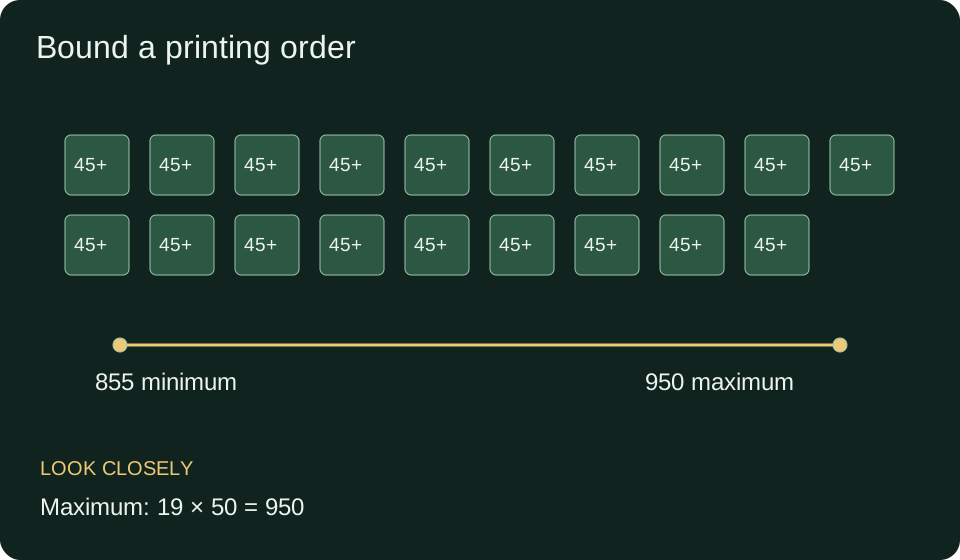
For the smallest total, make every pack as small as allowed. Nineteen packs of forty five cards give 855. Every allowed order has at least that many cards, provided all nineteen packs arrive and the pack counts follow the rule.
For the largest total, use fifty in every pack. Nineteen times fifty is 950. The actual total lies somewhere from 855 to 950, including the endpoints.
A convenient estimate might use about forty eight cards per pack: nineteen times forty eight is 912. That is a possible total, not a guaranteed total. Estimation and bounding solve different problems.
Teacher example: can we guarantee nine hundred cards?
- Identify the guarantee: every allowed case must contain at least 900 cards.
- Calculate the smallest allowed case: 19 × 45 = 855.
- Compare 855 with 900. It falls short by 45.
- Conclude that 900 is not guaranteed, even though some allowed totals exceed it.
Connect the example to the rule
Rounding can make a quick estimate easier. Nineteen is near twenty, so twenty packs of roughly fifty suggests about one thousand cards. Because both quantities were rounded upward, that rough calculation is above the true maximum here. Explain the direction of rounding rather than treating the estimate as exact.
Your turn, with support
How many cards are guaranteed if there are twenty packs, each still containing at least forty five?
Show one hint
Use the minimum in every pack.
Compare your working
900 cards, because 20 × 45 = 900. This depends on all twenty packs meeting the stated minimum.
A mistake worth understanding
The maximum being above nine hundred does not establish a guarantee. A guarantee must survive the smallest allowed case. The actual order may include smaller packs.
Check the idea before moving on
The interactive questions load when JavaScript is available. You can still use all written practice below.
Now solve without the example
- Ten boxes hold 8 to 12 pencils each. Find the total bounds.
- Do those boxes guarantee 100 pencils?
- What assumption fails if one box is missing?
Check the independent answers
- 80 to 120 pencils.
- No. The minimum is eighty, although one hundred is possible.
- The assumed count of ten boxes is no longer true; recalculate for the boxes actually present.
Use it in a new situation
You have fifteen sessions that each take 20 to 30 minutes. What range of total working time should you plan for, excluding breaks?
Compare a possible solution
300 to 450 minutes. Breaks and waiting are outside this model and need to be added separately.
What to take away
Ask whether you need a useful approximation or a guarantee. State the assumptions and test the extreme cases.
Before your next lesson
Close this page and explain the main idea in your own words. Rework one of the independent problems without looking. If a step is still unclear, return to the worked example and compare that exact step. Tomorrow, try the transfer problem again before opening its answer.
For a saved introductory check, open this lesson in your signed in workspace and choose Tests. Practice choices on this page are not a qualification or a substitute for independent work.
Next in this path: Probability: count the possible outcomes before guessing