
OTWONO LABS / NOTEBOOK
Measurements: describe the same length in different units
Learn one step at a time, with examples, practice and a place for your questions.
Start this lessonEveryday mathematics · LESSON 4 OF 6
Convert meters to centimeters and back while checking that the physical length stays the same.
Before you start: Multiply and divide by one hundred. Multiplying 2.4 by 100 gives 240; dividing 240 by 100 reverses that change.
Suggested pace: 20 to 35 minutes, with extra time for practice. You can stop after any section and return.
Start with something concrete
A ruler marked in centimeters and a tape marked in meters can measure the same board. They may display different numbers without disagreeing. A meter is a larger unit: one meter contains one hundred centimeters.
The words we will use
- Measurement
- A number together with its unit, such as 2 meters.
- Unit
- The standard amount used to measure something.
- Conversion
- Writing the same quantity using a different unit.
Understand the idea
If the unit becomes smaller, more units fit along the same length. One meter becomes one hundred centimeters. Two meters become two hundred centimeters. This is why meters to centimeters uses multiplication by one hundred.
To reverse the direction, group the centimeters into sets of one hundred. Three hundred centimeters contain three such groups, so they are three meters. Centimeters to meters uses division by one hundred.
Decimal parts describe part of a unit. In 2.4 meters, the 0.4 means four tenths of one meter, which is forty centimeters. In 2.04 meters, the 0.04 means four hundredths, which is four centimeters. The position of the digit matters.
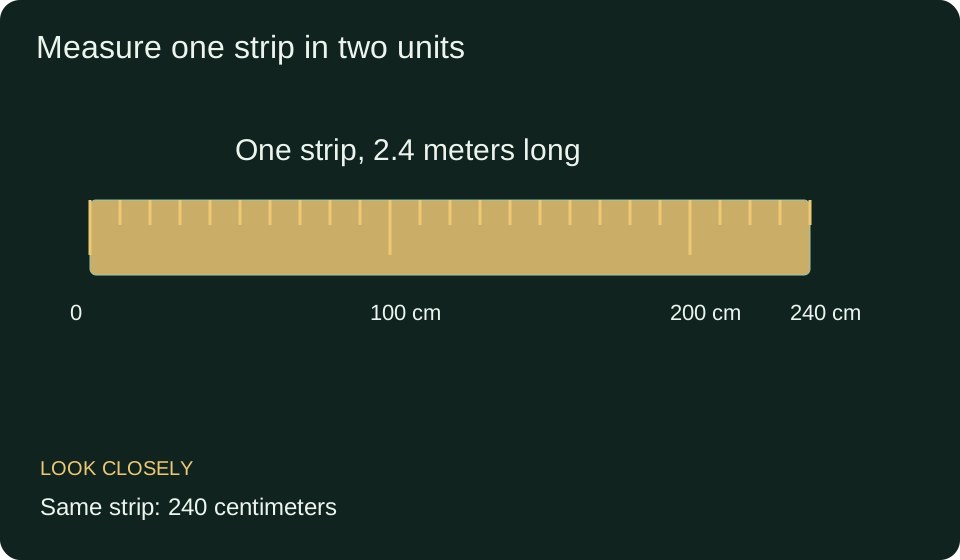
Teacher example: measure a strip 2.4 meters long
- Separate the length into 2 meters and 0.4 meter.
- The two full meters contain 200 centimeters.
- The remaining four tenths of a meter contain 40 centimeters.
- Add: 200 + 40 = 240 centimeters. Reverse the conversion: 240 ÷ 100 = 2.4 meters.
Connect the example to the rule
Keep units attached to your answer. The number 240 alone does not tell someone whether you mean centimeters, meters or something else. In a calculation, writing 2.4 m × 100 cm / 1 m shows that the meter units cancel and centimeters remain.
Your turn, with support
Convert 2.04 meters to centimeters using a whole part and a fractional part.
Show one hint
Four hundredths of a meter are four centimeters, not forty.
Compare your working
200 cm + 4 cm = 204 cm. Dividing 204 by 100 returns 2.04 m.
A mistake worth understanding
A square one meter on each side is not one hundred square centimeters. Each side is one hundred centimeters, so its area is 100 × 100 = 10,000 square centimeters. A length conversion must be applied to both dimensions when converting area.
Check the idea before moving on
The interactive questions load when JavaScript is available. You can still use all written practice below.
Now solve without the example
- Convert 3.5 m to cm and reverse it.
- Convert 450 cm to m.
- A rectangle is 2 m long and 30 cm wide. Find its area in square centimeters.
Check the independent answers
- 350 cm. Dividing 350 by 100 gives 3.5 m.
- 4.5 m because 450 divided by 100 is 4.5.
- Convert the length to 200 cm. Then 200 × 30 = 6,000 square cm.
Use it in a new situation
A display tool accepts millimeters. Convert a 1.2 meter strip using the fact that one meter is one thousand millimeters.
Compare a possible solution
1,200 mm. The same reasoning applies with a different factor. Verify that the tool expects millimeters before entering the number.
What to take away
Name the quantity and units. Decide which unit is smaller, use the correct factor and reverse the calculation to check.
Before your next lesson
Close this page and explain the main idea in your own words. Rework one of the independent problems without looking. If a step is still unclear, return to the worked example and compare that exact step. Tomorrow, try the transfer problem again before opening its answer.
For a saved introductory check, open this lesson in your signed in workspace and choose Tests. Practice choices on this page are not a qualification or a substitute for independent work.
Next in this path: Estimation: work out what an answer could reasonably be