
OTWONO LABS / NOTEBOOK
Equations: find a missing number without breaking the balance
Learn one step at a time, with examples, practice and a place for your questions.
Start this lessonEveryday mathematics · LESSON 3 OF 6
Solve a simple addition equation and verify the answer by putting it back into the original statement.
Before you start: Add and subtract small numbers. A letter is simply a placeholder for the unknown number in this lesson.
Suggested pace: 20 to 35 minutes, with extra time for practice. You can stop after any section and return.
Start with something concrete
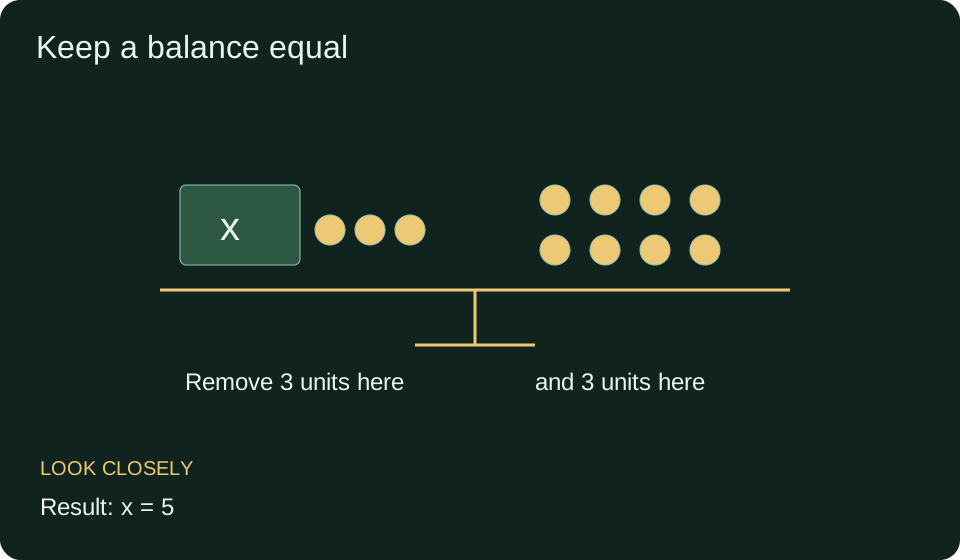
A closed box and three loose counters together have the same value as eight counters. How many counters does the box represent? We can write this situation as x + 3 = 8. The letter x stands for the box’s unknown value.
The words we will use
- Equation
- A statement that two expressions have equal values.
- Unknown
- A value we have not found yet, often represented by x.
- Inverse operation
- An operation that undoes another, such as subtraction undoing addition.
- Substitution
- Replacing the letter with a proposed number to check it.
Understand the idea
The equals sign does not mean ‘here comes the answer.’ It says the left and right sides have the same value. Picture a balanced scale. If you change only one side, it may no longer balance.
We want x by itself. Since three was added to x, subtract three to undo that addition. Subtract the same three from the right side to preserve equality. On the left, adding three then subtracting three leaves x.
After finding a value, return to the original equation. A calculation can contain a slip; substitution checks whether your proposed value actually makes the starting statement true.
Teacher example: solve x + 3 = 8
- Write the original equality: x + 3 = 8.
- Subtract three from each side: x + 3 − 3 = 8 − 3.
- Simplify each side: x = 5.
- Check by substitution: 5 + 3 = 8. Both sides are eight, so five is a valid solution.
Connect the example to the rule
Subtraction can also appear in the original problem. For x − 2 = 6, add two to both sides. You obtain x = 8, and 8 − 2 = 6 confirms it. Choose the inverse operation based on what is being done to x. Multiplication has an inverse too. In 4x = 20, 4x means four times x. Divide both sides by four to get x = 5, then check 4 × 5 = 20. Use division only by a nonzero number.
Your turn, with support
Solve x + 4 = 11. State what you do to each side, then substitute your result into the original equation.
Show one hint
Undo adding four by subtracting four on both sides.
Compare your working
x = 7. Subtracting four leaves eleven minus four on the right. The check is 7 + 4 = 11.
A mistake worth understanding
Writing x = 8 after removing three only from the left of x + 3 = 8 does not preserve equality. Substitution exposes the error: 8 + 3 is eleven, not eight.
Check the idea before moving on
The interactive questions load when JavaScript is available. You can still use all written practice below.
Now solve without the example
- Solve x + 6 = 14 and check.
- Solve x − 5 = 9 and check.
- A learner proposes x = 10 for x + 2 = 9. Use substitution to diagnose the mistake.
Check the independent answers
- x = 8; eight plus six is fourteen.
- x = 14; fourteen minus five is nine.
- Ten plus two gives twelve, so the proposed value does not satisfy the equation. Subtract two from both sides to get x = 7.
Use it in a new situation
You have some tokens and receive four more. You now have thirteen. Write an equation and find how many you started with.
Compare a possible solution
x + 4 = 13, so x = 9. The unknown represents the starting count, not the new total.
What to take away
Define the unknown, preserve equality, undo the operation and check the original statement.
Before your next lesson
Close this page and explain the main idea in your own words. Rework one of the independent problems without looking. If a step is still unclear, return to the worked example and compare that exact step. Tomorrow, try the transfer problem again before opening its answer.
For a saved introductory check, open this lesson in your signed in workspace and choose Tests. Practice choices on this page are not a qualification or a substitute for independent work.
Next in this path: Measurements: describe the same length in different units