
OTWONO LABS / NOTEBOOK
Ratios: keep a mixture the same while changing its size
Learn one step at a time, with examples, practice and a place for your questions.
Start this lessonEveryday mathematics · LESSON 2 OF 6
Build a larger mixture by repeating a complete group, then explain the difference between a ratio and a fraction of the whole.
Before you start: Count groups and multiply small numbers. The first lesson explains fractions if that word is unfamiliar.
Suggested pace: 20 to 35 minutes, with extra time for practice. You can stop after any section and return.
Start with something concrete
You are making a necklace. Your pattern uses two blue beads followed by three white beads. Write the pattern as 2 blue : 3 white. The colon means ‘compared with.’ Keep the color labels while learning so you do not reverse the order.
The words we will use
- Ratio
- A comparison of quantities in a stated order.
- Group
- One complete copy of the pattern being repeated.
- Scale factor
- The number by which every part of the pattern is multiplied.
Understand the idea
One complete group contains five beads, not three. The three in 2 : 3 counts white beads only. The fraction of the whole group that is blue is 2 / 5. The ratio of blue to white is 2 : 3. These statements describe the same group but answer different questions.
To make the necklace longer without changing the mixture, repeat the entire five bead group. Two copies contain four blue and six white. Three copies contain six blue and nine white. Both color counts grow by the same factor.
If you know the desired total, divide it by the size of one group to find the number of copies. If you know only one color count, compare that count with its matching part in the original pattern. Do not compare a color count with the total unless that is the quantity the question gives.
Teacher example: make a twenty bead necklace
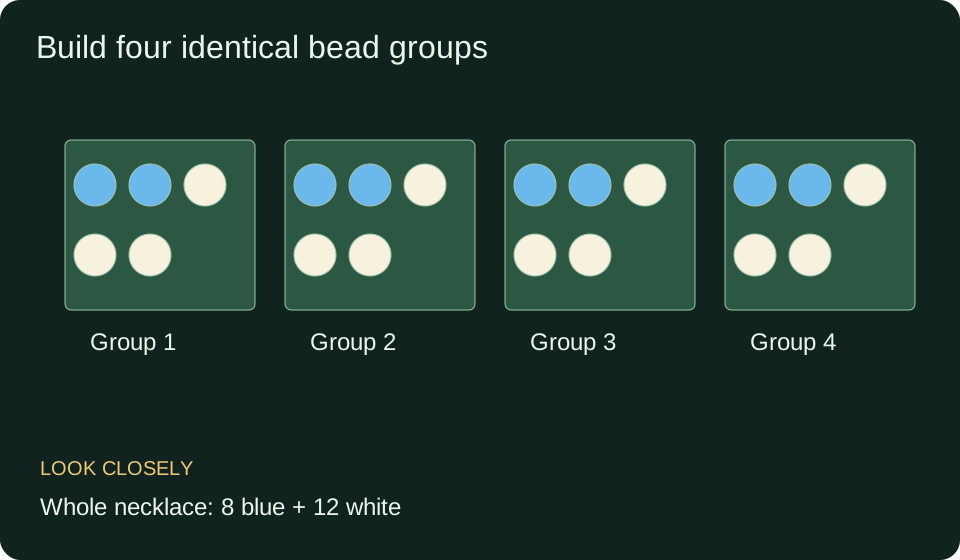
- One group has 2 + 3 = 5 beads.
- Twenty beads require 20 ÷ 5 = 4 complete groups.
- Count blue: 2 × 4 = 8. Count white: 3 × 4 = 12.
- Check the total: 8 + 12 = 20. Check the pattern: dividing both counts by four gives 2 : 3 again.
Connect the example to the rule
If you already had fifteen white beads, the factor would be 15 ÷ 3 = 5. You would need 2 × 5 = 10 blue beads. Here you used the white part to find the factor because white was the known quantity.
Your turn, with support
You want thirty beads altogether using the same pattern. Find the number of groups, then the number of each color.
Show one hint
Divide thirty by five before multiplying either color count.
Compare your working
There are six groups. They contain twelve blue beads and eighteen white beads. The total is thirty.
A mistake worth understanding
Adding four to both original counts gives six blue and seven white. That does not repeat the pattern. Six blue would require three original groups, but seven white is not the white count for those groups. Scaling changes both parts through multiplication, not equal addition.
Check the idea before moving on
The interactive questions load when JavaScript is available. You can still use all written practice below.
Now solve without the example
- Use three complete groups. Find each color count and the total.
- You have twelve white beads. How many blue beads preserve the ratio?
- For eight blue and twelve white beads, write the blue fraction of the whole.
Check the independent answers
- Six blue and nine white, fifteen total.
- Eight blue. Twelve divided by three gives a factor of four.
- 8 / 20 = 2 / 5. The blue to white ratio would instead be 8 : 12.
Use it in a new situation
A fictional drink uses two measures of concentrate to three of water. How much water goes with six measures of concentrate?
Compare a possible solution
Nine measures. The concentrate was multiplied by three, so the water must also be multiplied by three. Use the same measuring unit for both quantities.
What to take away
Name each part, find one complete group, identify the factor and multiply every part by that factor.
Before your next lesson
Close this page and explain the main idea in your own words. Rework one of the independent problems without looking. If a step is still unclear, return to the worked example and compare that exact step. Tomorrow, try the transfer problem again before opening its answer.
For a saved introductory check, open this lesson in your signed in workspace and choose Tests. Practice choices on this page are not a qualification or a substitute for independent work.
Next in this path: Equations: find a missing number without breaking the balance