
OTWONO LABS
How adaptive learning works
Use this walkthrough to turn reading into an explanation you can test. You can read public lessons without an account. Sign in to keep private notes, saved workspaces and a personal learning record.
1. Choose a lesson you can use
- Open the Knowledge Library to browse, or sign in and open Learn.
- In the learning workspace, use Find a lesson to locate a topic. Select a lesson, then open the Lesson tab.
- Read the goal and prerequisite check. If the prerequisite feels unfamiliar, practice that skill first. A title that sounds interesting is not enough to determine the right starting point.
Example: If you want to resize a recipe, start with Ratios and scaling. Before working on a new recipe, check that you can multiply a group of quantities by the same factor.
Expected result: The selected lesson title and its content appear in the Lesson tab. If the title does not change, select the lesson again and check for a visible loading or error message.
The full lessons use six steps: Start, Understand, See an example, Try together, Practice and Reflect. Use Continue or Previous step. Your current step is saved with your workspace. On mobile, switch between Lesson and Teacher chat. Reading progress does not award a scored result.
2. Predict, inspect and explain
- Write a prediction before opening an answer.
- Study the concrete example. Match each object, value or arrow in the image to the explanation below it.
- Explain why the step is valid. Saying only what changed is not yet an explanation.
- Try the next problem. Open the hint after making your own attempt.
- Compare your reasoning with the revealed answer. Repair the first incorrect step and try a changed example.
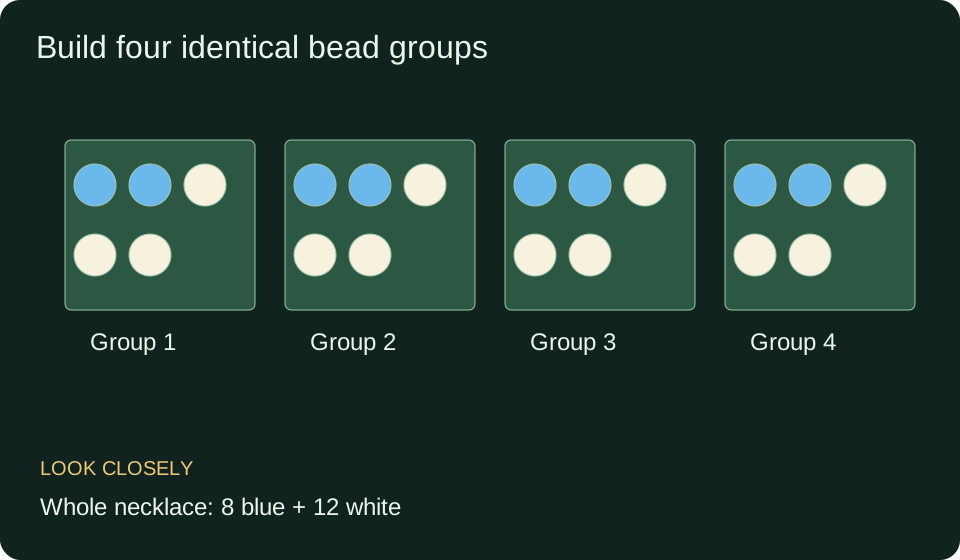
Sample explanation: One group contains five beads. Twenty beads require four complete groups. Four groups contain eight blue beads and twelve white beads. Adding four to each color would change the mixture rather than repeat it.
Try it: For thirty beads, predict the number of each color before counting. The answer is twelve blue and eighteen white because there are six complete groups.
3. Keep a useful private record
- In Learn, select New beside Workspace to create a separate place for your work. Use Rename to give it a meaningful name such as Recipe scaling practice.
- Open Notes and write your method, result and remaining question.
- Choose Save now. Wait for the status Saved to your account.
- Return to the workspace later and confirm your text is present. An open page alone is not evidence that the last edit reached the server.
Example note you can imitate
Goal: scale a mixture from five parts to twenty.
Method: twenty divided by five gives four groups.
Result: eight blue and twelve white.
Check: eight plus twelve equals twenty.
Uncertainty: I need more practice when the factor is not a whole number.
If saving fails: Keep the page open and use Export before reloading. Preserve a copy of important text. Read the displayed error rather than repeatedly creating new workspaces. Private notes are not automatically graded.
4. Separate practice from a scored check
- Complete an independent problem without looking at its solution.
- In the selected lesson workspace, open Tests.
- Answer the questions and choose Submit assessment.
- Read the feedback, revisit the explanation for an error and try another practice problem before using another attempt.
There are three attempts per lesson per UTC day. Some shorter notes do not have a scored assessment; the Tests tab explains when this is the case. A correct introductory check is evidence about those questions, not proof of complete expertise.
Answer by voice
In a supported browser, choose Answer by voice beside a practice or assessment question. Say an answer or an option number. Review the transcription, choose Use this answer, then check or submit when ready. Your browser may process audio online. You can always select an answer without a microphone.
5. Understand what grows and why
Record session records study activity. Record lesson completion records your own completion report. Neither button grades the written explanation. Your tree separates activity from assessed results.
| Action or evidence | Meaning in the current tree | What it does not prove |
|---|---|---|
| Record session | Study activity for a subject | That the lesson was understood |
| Unique completed lesson | Contributes to branch length | Independent mastery |
| Latest introductory checks | Contribute to branch thickness | A permanent measure of ability |
| Fully correct topic check | Earns a topic leaf retained in history | An accredited qualification |
Open Your tree and inspect the subject details. For example, completing one lesson twice does not count as two different completed lessons. Interests alone do not earn leaves. The evidence list is the way to understand a change in the drawing.
What happens to an AI question today?
AI remains disconnected. Save question stores your question as a draft without generating a reply. You can still use every published lesson, keep notes and take available assessments. Do not wait for an AI response that the interface says is unavailable.
Your next study session
Choose one lesson, solve one new example and explain one mistake you learned to avoid. Tomorrow, try to reconstruct the method without reading first. Compare your attempt with the lesson and record the gap you want to practice next.